
Rahu And Ketu: Serpents Of Karma, Catalysts Of Transformation
Published on in Planets In Astrology
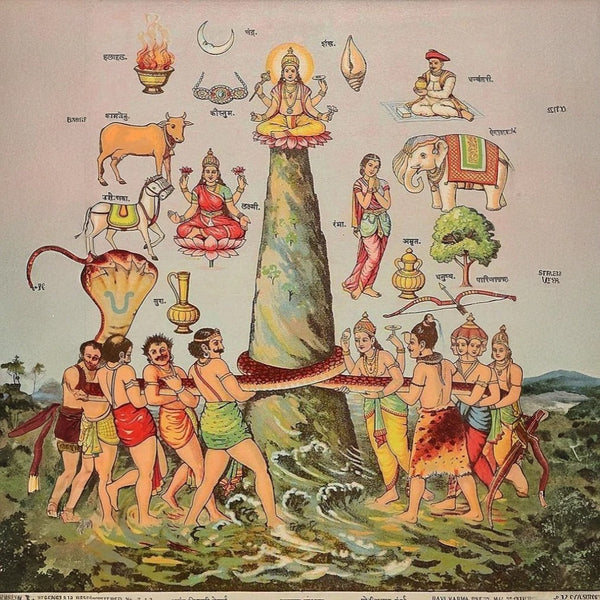
Rahu and Ketu are the two mathematical points and are considered the north and south nodes of the Moon, depicted as a serpent who, at the time of the great churning, went to drink the nectar, after which the Sudarshana Chakra of Vishnu Ji cut the serpent in half, one of which, the head, became Rahu, and the tail, Ketu.
Their nature can also be understood in the same way, where Rahu brings out the cunning, manipulative, smartly intelligent side of a person, and Ketu purely acts on its intuition, as a tail does. When Rahu and Ketu felt betrayed by the luminaries Sun and Moon, who told Vishnu Ji of the serpent’s deeds, they began to eclipse both of them at certain times in order to cover the light, the shine through which they manifest their auspicious energy, and to bring to the world evil and destructive events, so anyone who gets under the shadow of the eclipse may suffer.
But nonetheless, it is because of Rahu that every other planet is able to materialize its results, and it is because of Ketu that one can attain intuition and realize divine guidance. Without them, Jupiter, Saturn, Mars, Mercury, and Venus cannot provide any material results.
They are also known as the planets of karmic energies; as they have no tangible existence, they work with time as an entity to provide the fruits of past karma into the present one.
Rahu in modern times provides one with great sudden success, social contacts, the ability to bring out something new, and a great level of spirituality if strongly placed. If badly placed, it can unleash hell in life in terms of wealth, health, and family.
Ketu in modern times acts as Mars; the reason it is called "Kujavat Ketu" is due to its ruling over Scorpio and acting as a sudden blasting agent because of whom wars and chaos, which are acted upon without thinking, are manifested.
As Ketu has no head, so the ones initiating wars have no reasoning. Rahu and Ketu transit for approximately 1.5 years in one sign. Rahu is full of desire and so rules the material trine, where its nakshatras—Ardra, Swati, and Shatabhisha—prevail.
Whereas Ketu is full of spiritual fire and so rules over the fiery trine with nakshatras—Ashwini, Magha, and Moola. Through these nakshatras, one can understand the significance of the transformation they bring in a person’s life, which, if one does not resist and goes with the flow, is blessed, and the one who resists their transformation suffers.
Related Products


More Articles


